Direct-to-Consumer vs. Clinic-Based FemTech Business Models
The two FemTech models split on who pays, reshaping everything from sales to survival.
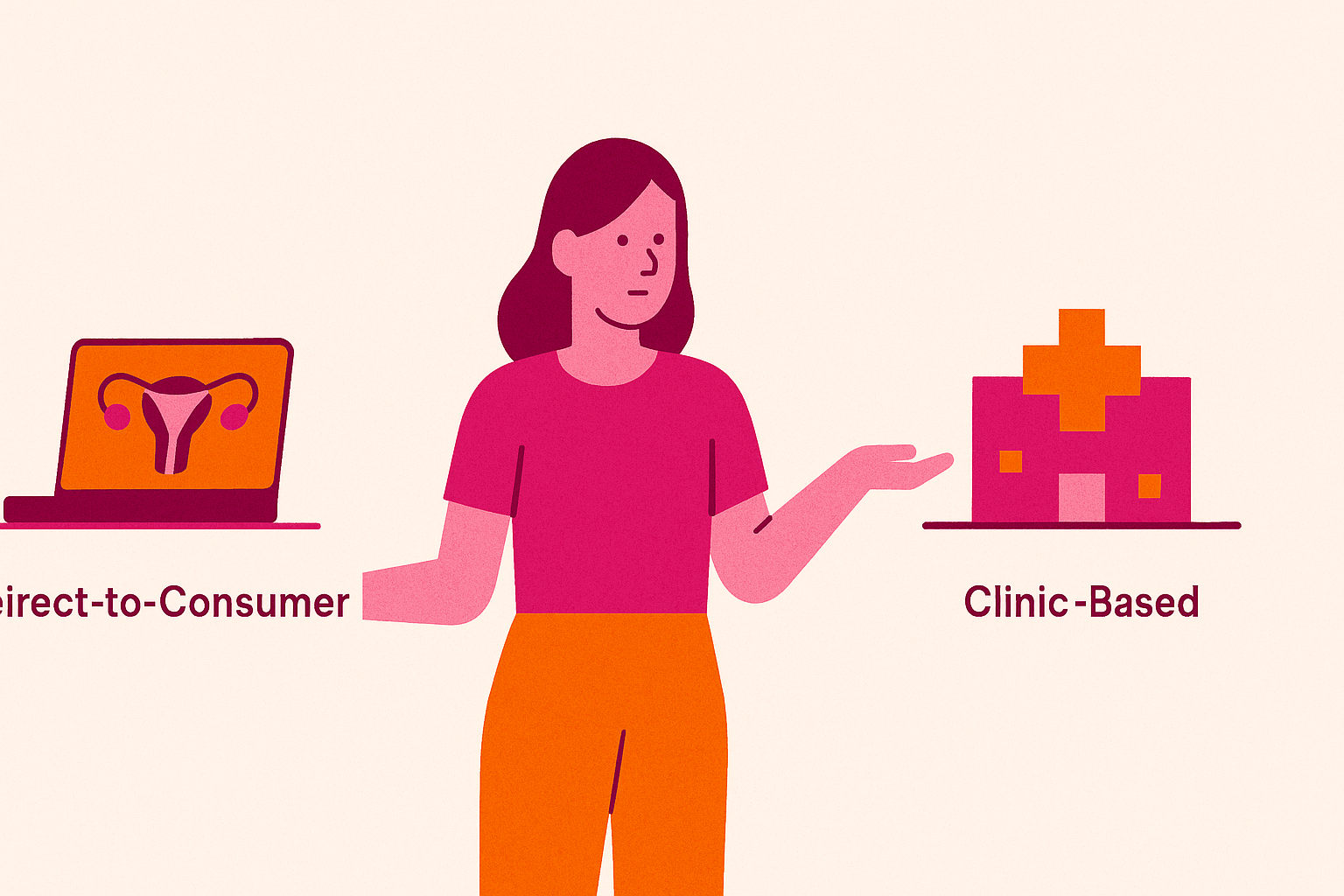
FemTech splits into two business models that look nearly identical on a pitch deck and behave nothing alike on a balance sheet. One has a woman paying for an app or device out of her own pocket; the other has an employer, health plan, or hospital system footing the bill on her behalf. Grand View Research put the global FemTech market at $39.29 billion in 2024, headed toward $97.25 billion by 2030, and venture capital poured a record $2.6 billion into women's health in 2024, up 55% from the year before. Big numbers, sure, but they don't tell you which model keeps that money, or why a founder building a menopause app is solving a completely different problem than one building an IVF navigation tool for employers.
Neither model wins outright. The tradeoffs get baked in from day one, and they decide how a founder builds, prices, and sells, whether she realizes it at the seed round or figures it out the hard way at Series B.
What actually separates DTC FemTech from clinic-based FemTech
Who pays, and who gets paid, is the whole split, once you strip away the branding. DTC FemTech sells software, devices, or subscriptions straight to the person using them, no middleman writing the check. Flo Health and Natural Cycles run the classic version: freemium apps that convert a slice of free users into paying subscribers. Elvie does the same thing in hardware, selling pelvic floor trainers and breast pumps directly to the woman who'll use them. It's the biggest slice of the market by a wide margin: Grand View Research had DTC at 30.82% of global FemTech revenue in 2024, and Global Market Insights pegged it near $21.5 billion for 2025.
Clinic-based FemTech flips the arrangement. The technology gets built into, or sold alongside, actual care delivery, and the check comes from an employer, a health plan, or a hospital system, not the patient. Maven Clinic is the cleanest example: a virtual clinic sold B2B2C to employers, who hand it to employees as a benefit. Progyny and Carrot Fertility work as benefits navigators, administering fertility coverage for companies. Kindbody runs a hybrid: it owns physical clinics while also selling employer contracts. Levy Health skips patients and employers entirely and sells software straight to clinics. The employer channel is where the real institutional money sits; 40% of large US employers offered fertility benefits by 2024.
The distinction that matters is who decides to buy. Is it the woman herself, downloading an app because her cycle tracker crashed at 2am? Or an HR benefits manager comparing vendor proposals on a spreadsheet three months before open enrollment? That one fact runs through everything below it: sales cycle length, regulatory exposure, how trust gets built, who owns the data, what a customer is worth five years out. One mix-up worth clearing up now: telehealth is a delivery mode, not a business model. Maven delivers care over video, which looks DTC on the surface, but the employer pays. The channel defines the model; the video call is just how the appointment happens to occur.
How each model finds its customers, and what that costs
DTC acquisition is fast, and it's getting expensive in a way that should worry anyone modeling five-year growth off last year's spreadsheet. No intermediary stands between the company and the buyer, so paid social, App Store optimization, and influencer deals do the heavy lifting. Customer acquisition cost for DTC subscription brands rose 40 to 60% between 2023 and 2025, and 88% of subscription brands reported higher CAC in 2025 than the year before. Flo Health got to 70 million monthly active users this way, and getting there took sustained, heavy paid-media spend. The math gets harder every quarter as ad platforms fill up and prices climb.
Viral loops kick in once a company is big enough, word of mouth inside a cycle-tracking subreddit does real work. But that only happens after a company has already spent enough to build the audience that makes word of mouth possible in the first place.
B2B acquisition runs on a completely different clock. Enterprise sales cycles stretch for months, sometimes close to a year, dragging through legal review, procurement, and HR sign-off before a single employee logs in. Maven Clinic built over 2,000 enterprise relationships this way, charging a base platform fee somewhere around $20,000 to $40,000 a year per employer, plus per-member fees on top. It's a slow, expensive sale, but once the contract is signed, the entire covered employee population gets enrolled in one motion, no per-user ad spend required. Distribution scales with the employer's headcount, not a marketing budget. There's a network effect here that DTC just doesn't have, either: benefits leaders talk to each other, benchmark against peer companies, and one strong reference customer carries more weight than a hundred five-star App Store reviews.
DTC moves fast and goes global, but CAC keeps climbing every year it runs. B2B is slow and expensive to close, but per-user economics improve as contracts get bigger. A cycle-tracking app with broad, low-stakes appeal fits the volume game DTC plays. An IVF navigation platform, expensive and high-touch by nature, can wait a year for a signature, because the contract is worth the wait once it lands.
Retention behaves differently depending on who signs the check
Churn is where DTC FemTech quietly bleeds out. Recurly's 2024 benchmark put average consumer subscription churn at 6.5% monthly; Recharge's DTC-specific panel ran even higher, 7.1%, split between 4.1% voluntary cancellations and 3.0% involuntary (expired cards, failed payments, the boring stuff that still costs real money). Run 6 to 7% monthly churn for a full year and a company has lost a huge chunk of its subscriber base. The marketing budget never gets to rest; it has to keep refilling a bucket with a hole in the bottom just to hold revenue flat, forget growing it.
FemTech carries a churn driver baked into the category itself, and no clever win-back email fixes it. Life stages end: a woman using a fertility-tracking app gets pregnant and doesn't need it anymore, a menopause app user finishes menopause, by definition, and there's no renewing that subscription forever. A contraception app goes stale the day she switches methods. None of this is a product failure. It's a lifecycle transition that creates an exit no engagement feature can block, and add the FTC's Click-to-Cancel rule, finalized in October 2024, which requires canceling to be exactly as easy as signing up, and a real retention lever, plain old friction, just got regulated out of existence.
B2B retention plays by different rules, because the thing renewing isn't a person's mood, it's a contract. Maven Clinic reports a 98% enterprise retention rate, and that number means something structurally different from a consumer churn figure. Enterprise buyers don't cancel a benefits platform the way someone cancels a $9.99 app subscription on a whim, since switching costs, a new procurement process, HR communications, and employee re-onboarding all keep institutional buyers locked in. But the risk just relocates: a recession hits, a company slashes its benefits budget, and an entire covered population vanishes from the platform in a single board meeting. There's no individual-subscriber loss that size.
Put the two together and DTC lifetime value gets squeezed from both directions at once: rising CAC pushing in, chronic churn pulling out. B2B lifetime value runs higher per relationship, but it concentrates in fewer accounts, so losing one big client hurts more even though it happens less often. Maven averages roughly $2,300 in revenue per enrolled member, several times what earlier consumer women's health apps ever pulled per user. DTC products have to become daily habits just to survive their own churn curve. Clinic-based products have to prove hard ROI numbers at every single renewal, or the account walks.
What regulators demand from each model, and how differently they demand it
DTC regulation is a moving target, and the target keeps moving faster than most founders can update their compliance docs. The second an app claims to diagnose or treat something, rather than just track it, FDA jurisdiction shows up uninvited. Natural Cycles remains the only FDA-cleared digital contraceptive app on the market, and its $55 million raise in 2024 went partly toward the regulatory and commercial work that clearance actually demands. Then there's the post-Dobbs landscape, which changed the emotional and legal weight of reproductive data overnight, not gradually. Worries about menstrual and fertility data ending up with law enforcement, insurers, or employers aren't hypothetical anymore, and researchers have flagged real risk that cycle data gets sold to data brokers if left unregulated. DLA Piper's 2026 analysis names FemTech providers as prime cybersecurity targets precisely because the data is intimate and commercially valuable at the same time, a combination that makes for a genuinely hard privacy problem. Add GDPR overseas and a patchwork of state privacy laws at home, and a consumer app running across several markets ends up juggling rulebooks that don't agree with each other.
B2B regulation is heavier on paper but far easier to plan around. HIPAA applies in full, no ambiguity about covered entity or business associate status, and enterprise buyers audit for exactly this before they'll sign anything. Telehealth licensing adds friction; state-by-state medical licensing rules slow down how fast a virtual clinic can expand across the US. Employer benefits programs have to work inside ERISA, ACA nondiscrimination rules, and a growing pile of state mandates on fertility coverage. It's a real burden, but a knowable one, and that predictability doubles as a competitive moat, since a new entrant can't just show up and sell into the employer channel without clearing the same bar everyone before it had to clear.
Here's the trap waiting for founders sitting between the two models: a DTC company that decides it wants to make clinical claims, or wants to sell into the employer channel down the line, isn't looking at a gentle ramp. Compliance requirements jump all at once, and that jump has to get planned for well before it becomes the thing blocking the next funding round, or the next enterprise deal that was supposed to close by end of quarter.
Trust gets built two different ways, and it's a clinical asset either way, not a soft metric
DTC trust gets built one download at a time, through the product itself and through how safe the data feels in someone's hands. Flo Health employs more than 120 doctors and health experts to build and check its medical content, a deliberate signal that the app wants clinical credibility, not just a clean interface. But that trust has taken real damage since Dobbs, and the privacy question stopped being an abstract legal footnote and became the trust question, full stop. Women's health tech is getting less forgiving of vague wellness claims by the month; the era where an app could get away with unverified symptom-tracking claims is closing, and closing fast. Scale cuts both ways here, too: 70 million monthly active Flo users buys enormous credibility, but it also invites 70 million users' worth of scrutiny. Someone is always watching, and increasingly, that someone works for a regulator.
Clinic-based trust runs on different fuel: outcomes data and institutional backing. Maven Clinic points to a 27% reduction in NICU stays, translating into roughly $9,600 saved per birth for the employers footing the bill. That number is the actual mechanism that earns the model its trust. Employers and health plans want outcomes evidence before they renew, and trust gets re-earned every year through demonstrated ROI, not through daily engagement stats nobody in HR is checking anyway. There's also something a consumer app can't fake: the provider-patient relationship, even over a video call, carries a built-in trust structure that no amount of well-written blog content quite replaces.
Where do the two paths meet? Both are getting pushed toward the same finish line: DTC by regulators and increasingly skeptical users, clinic-based by buyers who won't renew without proof. Whichever model a founder picks, the companies still standing five years out tend to be the ones that treated trust as part of the product from day one instead of something a marketing team bolts on after the fact.
Which conditions and product types actually fit each model
DTC fits conditions that are common, lower-stakes, and mostly self-managed. Menstrual tracking, general fertility awareness, everyday wellness monitoring: none of it needs a doctor in the loop, and the barrier to trying the product is close to zero. The user is the decision-maker from start to finish, and the intervention is behavioral, not procedural; nobody needs a prescription to start logging a cycle. DTC also has a geographic edge clinic-based models genuinely can't touch on cost: software crosses borders without a single physical clinic getting built. Flo offering free Premium access across 66 countries is exactly the kind of move only a software-first model can pull off that cheaply.
Clinic-based fits the opposite end: high-acuity, high-cost conditions where clinical oversight isn't optional and where an employer has real money riding on the outcome. Fertility treatment navigation, IVF benefit management, maternal health, menopause care involving actual prescriptions; these are conditions with measurable costs attached, which is exactly what makes an employer willing to pay to manage them better. Kindbody's decision to own clinics and sell employer contracts at the same time makes sense precisely because fertility care checks every box at once: expensive, high-stakes, employer-financed.
Then there's the gray zone, conditions that start as a wellness app and grow into something clinical whether the founder planned for it or not. Menopause is the clearest case. It started as a DTC symptom-tracking category and is now sliding toward telehealth prescribing and employer benefits; menopause care was among the fastest-growing employer benefit additions in the 2024 to 2025 window. Endometriosis tells a similar story: chronic, historically under-diagnosed, high-impact. DTC symptom tracking works fine as an entry point, but actual diagnosis and treatment need the kind of clinical infrastructure only a clinic-based model can provide. Rough rule of thumb: low acuity and self-managed points toward DTC, high acuity with employer financing points toward B2B, and rising acuity points toward hybrid, or toward a company quietly outgrowing whatever model it started with.
What company stage and funding reality do to the choice
Early-stage capital gravitates toward DTC, and it's not much of a mystery why. A DTC company can show user growth, engagement charts, and subscription revenue within a year or two, exactly the fast feedback loop that makes for a good seed or Series A story in a pitch meeting. B2B companies take longer to show comparable traction, since closing one enterprise contract alone can eat most of a year.
And yet, look at where 2024's money actually went. Flo Health raised $200 million and Maven Clinic raised $125 million, together accounting for 43% of that year's total $753 million in FemTech funding. That's capital chasing proven scale, not early bets. The biggest checks went to companies that had already answered the hard questions before anyone got around to asking them.
B2B models cost more to reach meaningful revenue, no getting around that. But the economics that show up afterward tend to hold up better once the ink dries. Maven's estimated $268 million in annual recurring revenue, paired with that 98% enterprise retention rate, is what you'd expect from a capital-intensive model that front-loads its costs into long sales cycles and gets paid back in durability. DTC buys speed and a growth story that plays well in a room full of VCs. B2B buys a slower climb and a much harder floor to fall through once a company has gotten up there. Which one a founder should pick isn't a formula so much as an honest look at three things: the condition she's building for, the stage she's raising at, and whether her cap table has the stomach for a sales cycle measured in quarters instead of app downloads.