Demographic Segmentation for Women's Health Audiences
Forget age bands—segment women's health audiences by the clinical question they're asking.
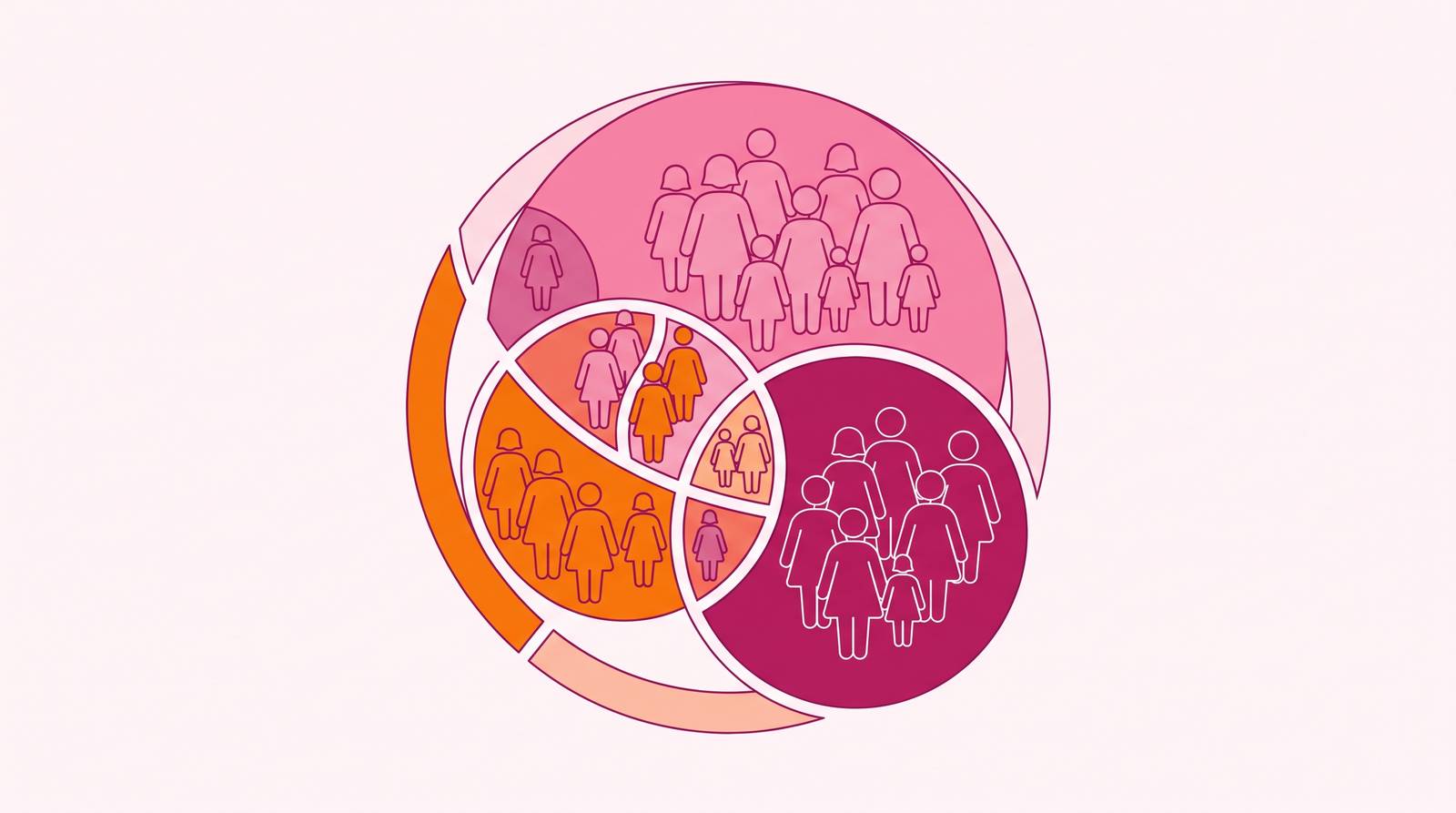
Life stage is not a euphemism for age band. That distinction matters more than most people in this industry are willing to sit with.
A grouping by life stage is defined by shared clinical context, shared decision-making mode, and shared information need. Those three variables do not move in lockstep with birthdays. They move with biology, circumstance, and system access. A woman asking "should I freeze my eggs?" and a woman asking "is this hot flash normal?" are operating in entirely different cognitive and emotional registers, even if a demographic pull drops them into the same 35-to-49 bucket. The age band tells you almost nothing useful. The question she's asking tells you everything.
What actually shifts by life stage: the primary health concern, who else is in the decision loop, the urgency and emotional charge of the decision, and the channel through which she's most likely to find and trust information. A partner, a clinician, an insurer, the woman sitting alone at midnight with her phone. Each of these constellations calls for a different approach, and confusing them is not a minor editorial misstep. It's a trust problem.
For practical strategy, four life stages carry the most weight: adolescent and early reproductive years, the core reproductive span, the perimenopause and menopause transition, and the post-menopausal phase. These segments are deliberately porous. Perimenopause can begin in the early 40s. A 62-year-old is still managing acute vasomotor symptoms. The framework is a scaffold, not a constraint, and it only functions correctly when validated against behavioral signals rather than assumed from age alone.
Reproductive-age women as the largest and most internally diverse segment
Adult women in the core reproductive years represent just over half of U.S. women's health market value as of 2025, per Mordor Intelligence. That number is useful for market sizing and almost useless for content strategy.
The internal variation within this cohort is enormous. Contraception, fertility, prenatal care, postpartum recovery, PCOS, endometriosis: these are all technically "reproductive-age women's health." They do not share an emotional register, a decision urgency, or a preferred information format. Treating them as one category produces content that is technically on-topic and practically irrelevant. I have watched brands do this repeatedly and wonder why their engagement metrics look like a shrug.
L.E.K. Consulting's 2024-2025 primary research, drawing on 590 U.S. women's health consumers, identified four distinct behavioral personas within just the maternal health and family-building slice of this cohort. The wellness seeker gravitates toward mental health and holistic content with a lifestyle frame. The fertility maven is actively comparison-shopping fertility products, cost-sensitive, and wants clinical specificity with transparent pricing. The loyal postpartum parent, most likely currently postpartum, needs practical care guidance and mental health support, and builds high brand loyalty once trust is earned. The patient is navigating a high-risk pregnancy context and wants authoritative, provider-grade information above everything else.
These four personas are not edge cases. They are the audience. A single content strategy targeting "women 18-45" will serve none of them adequately, or by accident serve one while actively alienating the others.
Two additional signals matter here. PCOS affects between 5 and 10 percent of women aged 15 to 44 in the United States, a prevalence large enough to warrant dedicated content tracks, not sidebar mentions tucked into broader reproductive health coverage. And cost sensitivity is a documented purchase driver: women aged 18 to 44 bear the highest out-of-pocket prescription costs of any women's health segment. Price transparency and cost framing are not incidental considerations. They are conversion variables.
The perimenopause and menopause transition as the fastest-growing content opportunity
The numbers are large and worth stating plainly. By 2025, over one billion women globally were anticipated to reach menopause. Nearly three-quarters of them experience vasomotor symptoms. The menopause management market was estimated at $17.79 billion in 2024 and is projected to reach $24.35 billion by 2030, growing at a 6.56 percent compound annual rate through 2031 in the U.S. alone.
The content landscape remains underbuilt relative to all of that. Not because the audience is hard to find, but because this cohort was systematically dismissed by health media and marketing for decades. Under-diagnosed, under-informed, treated as a demographic past her commercial relevance. The market is catching up to a gap that was never economic; it was a failure of attention, and frankly, a failure of imagination.
Awareness is rising. By 2025, 65 percent of women aged 40 to 60 reported increased knowledge of menopause symptoms and available therapies, per the U.S. Department of Health and Human Services. The regulatory environment is also shifting in ways that create immediate obligations: in February 2026, the FDA removed cardiovascular and breast cancer warnings from several menopausal hormone therapy product labels, meaningfully changing the clinical narrative around HRT. Content that was accurate six months ago is now incomplete. Brands publishing in this space need to update their treatment landscape coverage now, not at the next editorial planning cycle.
Capital is tracking the audience too. Midi Health raised a Series C in October 2025 to scale virtual perimenopause and menopause care. Hims & Hers launched a dedicated menopause specialty the same month. These are not trend pieces. They are market signals about where health-literate women in their 40s and 50s are directing their attention and their spending.
The content priorities for this life stage are specific. Symptom education covering vasomotor symptoms, sleep disruption, and mood changes should explain what is happening and why, in language that validates rather than clinicalizes the experience. Treatment navigation needs to be current. Trust-building content matters disproportionately here because this cohort arrives with a reasonable, well-earned skepticism toward health media that spent years looking past them. And digital delivery is more viable than most brands assume: 22 percent of women aged 40 to 60 worldwide used AI-enabled health monitoring apps for symptom tracking in 2025, per the WHO. They are not waiting for the industry to take them seriously. They have already started solving it themselves.
Post-menopausal women and the chronic condition pivot
The 50-and-above segment is projected to grow at the fastest compound annual rate in the overall women's health market, driven by population aging, longer life expectancy, and the accumulation of chronic condition burden. The clinical profile shifts fundamentally at this stage. The central concerns move from reproductive and transitional to degenerative and ongoing, and the content has to move with them.
Bone health is the most quantifiable illustration. Of an estimated 10 million Americans with osteoporosis, approximately 8 million are women. Cardiovascular risk rises sharply after menopause and remains chronically undercovered relative to the attention men's cardiac health receives. Depression affects twice as many senior women as men, most commonly between the ages of 40 and 59. Urogenital health, cognitive preservation, and pain management become prominent organizing concerns as well.
The content orientation shifts from "what is happening to my body" to "how do I manage this over years." That is not a subtle difference. It changes format: longer condition-management guides over short explainers. It changes tone: less discovery-oriented, more navigational. It shifts what decisions the content needs to support, with more weight given to insurance coverage, provider relationships, and the increasing reality that many of these women are also managing healthcare decisions for aging parents or a partner.
That last point is worth dwelling on. Marketers frequently treat 60-plus women as passive recipients of health information. The evidence does not support that. This cohort is digitally active, research-driven, and often functioning as the primary healthcare decision-maker for an entire household. They are not a diminishing audience. They are a consolidating one, with more purchasing authority and more at stake than almost any other segment in this market.
Where racial and ethnic identity cross-cuts every life stage
Life-stage segmentation is necessary. It is not sufficient on its own.
A Black woman at 32 navigating prenatal care and a white woman at 32 navigating the same clinical path face structurally different realities. The maternal mortality rate for Black pregnant people is 69.9 deaths per 100,000 live births, the highest in the nation. Content about prenatal care that does not address this disparity is providing a partial map to an audience that needs a complete one. That is not a political statement. It is a content accuracy problem.
The same structural dynamic appears in breast cancer. Non-Hispanic Black women are as likely as non-Hispanic white women to be diagnosed with breast cancer, but are 40 percent more likely to die from it. Awareness content that treats this as a uniform-risk condition is calibrated to a cohort it does not actually serve.
Trust functions as a content variable in this context, not merely a brand aspiration. Lived experience of medical dismissal shapes how women from different racial and ethnic backgrounds engage with health information. Who delivers the message, what community signals surround it, whether the platform visually and culturally reflects the audience: all of these affect whether the content lands as credible or as another instance of an industry that has historically looked past them. You cannot art-direct your way around that. It has to be structural.
The practical implications are concrete. High-disparity conditions within each life stage warrant segment-specific content tracks. Community-sourced voices and culturally resonant framing are not supplementary additions; they are the mechanism through which trust is established. And acknowledgment of systemic barriers, including access limitations, cost structures, and provider bias, belongs in the body of the content, not in a footnote.
How digital behavior and channel preference vary by life stage
Nearly 81 percent of U.S. women aged 18 to 64 had a regular healthcare provider in 2025, per KFF. Provider relationships do not eliminate the demand for digital content; they contextualize it. Women use content to prepare for appointments, extend the conversation after them, and navigate the gaps between visits that are often longer than anyone would like. Channel strategy needs to reflect that function, not just the demographic.
Reproductive-age women in the 18-to-45 cohort have high social and peer-community orientation. Reddit, Instagram, and TikTok operate as primary discovery channels for health information in this group. They are mobile-first and expect frictionless transitions from content to action, whether that means booking an appointment, purchasing a product, or tracking a symptom. Personal narrative, expert Q&A, comparison content, and condition explainers with a clear next step perform well here.
The perimenopause cohort defies the assumption of lower digital engagement. The WHO's 2025 data showing 22 percent of women aged 40 to 60 using AI-enabled health monitoring apps represents a group actively using digital tools to make sense of symptoms they do not yet have language for. Search-driven discovery is particularly strong because this cohort is often encountering health experiences that were not adequately described to them by their providers or their peers, and they arrive at a search bar with a specific, sometimes frightened question. SEO-optimized long-form content that meets a specific symptom query with specific, credible information performs well. Community formats, forums, newsletters, podcasts, also resonate because peer validation carries weight when a woman is not sure whether what she is experiencing is normal.
The 60-plus cohort is most reliably reached via email, longer editorial formats, and trusted health publication partnerships. Trust signals carry more weight than social proof here. Credentials, institutional affiliations, and named experts matter more than engagement metrics. The caregiver dimension often expands content interest beyond personal health to family healthcare management broadly, which opens content categories that brands in this space tend to underdevelop.
Publishing the same content across all channels simultaneously collapses the life-stage distinctions the segmentation framework was built to preserve. Distribution decisions must reflect the framework. The platform's algorithmic incentives are not a substitute for that judgment.
Putting the segmentation to work: from framework to content brief
The place where most brands lose this is not conceptual. They accept the life-stage thesis. They fail at execution because they lack a repeatable briefing process that carries the segmentation from strategy into the production workflow. The framework lives in a deck. The writers never see it.
A life-stage content brief needs to resolve six things before a word is written: the segment's primary health concern and the specific decision moment being addressed; the emotional register, whether this audience is anxious and searching, informed and comparing options, or managing an ongoing condition over years; who else is in the decision loop and whether the content should address them directly or simply account for their presence; the racial and ethnic overlay if the topic carries a documented disparity; the format and channel that fits the cohort's actual discovery behavior; and the specific action the content is designed to enable.
Speed matters structurally in this space. Women's health attracted $671 million in investment in 2024 alone. New entrants are moving quickly, and brands that require months to produce segment-specific content will find the conversation has already moved on. Strategy-first production discipline, where the segmentation framework is embedded in the briefing workflow before writing begins rather than retrofitted in editing, separates brands that scale content quality from brands that only scale volume.
AI-assisted content tools that can hold segment context across multiple life-stage tracks offer a real efficiency advantage here. Briefing individual writers separately for each cohort creates quality drift; a system that embeds the brief parameters into the production process reduces that drift at scale.
The measure of whether the segmentation is working is not reach. It is whether the woman on the other end of the content recognizes her specific situation in it, gets what she actually came for, and knows what to do next. That outcome is only achievable when the framework survives contact with the production process.