Market Segmentation Examples in FemTech Campaigns
FemTech campaigns fail when they skip product-to-audience mapping before the first brief is written.
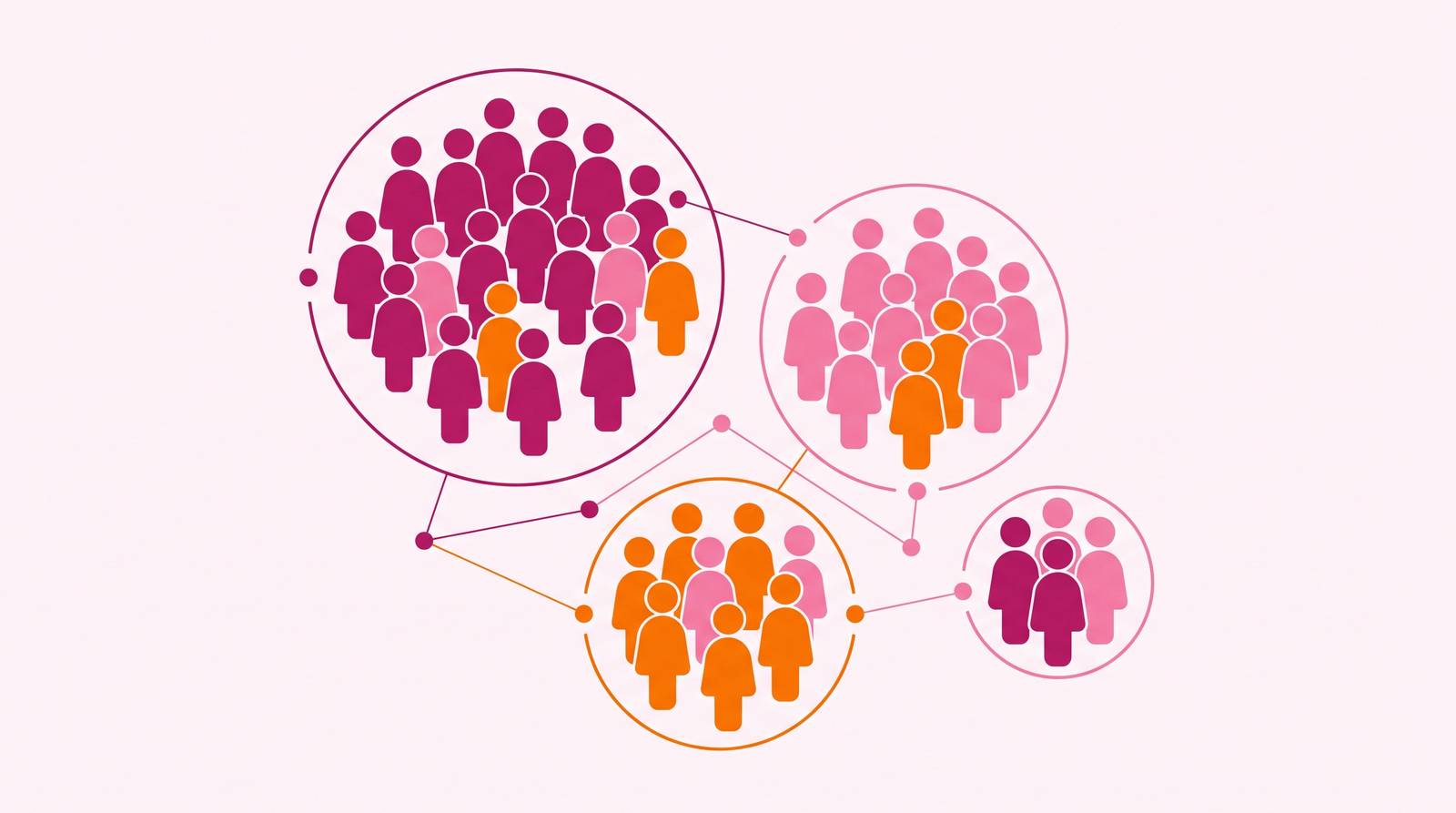
Analysts segment FemTech by product type, application, end-use channel, and condition. Each axis has a direct marketing counterpart. Map them explicitly, because the product you sell pre-selects the audience layer you start from, and skipping that step is where generalist campaigns go wrong before a single brief is written.
By application, pregnancy and nursing care led with a 20.45% revenue share in 2025. Menstrual health is the fastest-growing application segment at a 17.56% CAGR. A pregnant woman in her second trimester is managing a known condition with a defined timeline. A 19-year-old downloading a cycle tracking app is building a health literacy habit for the first time. Those are not the same creative problem.
The end-use channel data is its own psychographic signal, if you know how to read it. Direct-to-consumer dominated at a 35.66% share in 2025, sustained by e-commerce infrastructure, discreet purchasing preferences, subscription models, and influencer-driven acquisition. That channel dominance tells you something real about the buyer before you have written a word: she is privacy-aware, self-directed, and made a deliberate choice to bypass a clinical setting. Hospitals, meanwhile, are the fastest-growing end-use channel at a 17.45% CAGR. A B2B clinical buyer in a hospital procurement cycle has essentially nothing in common with that DTC consumer — professional role, institutional budget cycles, regulatory compliance posture, different conversation entirely. Running shared creative across those two funnels is a waste of spend that shows up in the numbers long before anyone admits the strategy was wrong.
Software is the fastest-growing product type at a 17.23% CAGR, and this matters beyond the revenue figure. App-based products generate behavioral data that physical devices alone cannot. An app logging daily inputs builds a longitudinal user profile that sharpens over time. A blood pressure cuff does not. The segmentation sophistication gap between software-first and hardware-first FemTech companies is, in large part, a data infrastructure gap, and it is widening.
A perimenopause symptom app and a clinical fertility monitor are both sold to "women aged 35 to 45," but those audiences diverge by life stage, health journey, and psychographic orientation in ways that make them functionally distinct cohorts. The product taxonomy is your first segmentation input. It is not a shortcut to the last one.
Life-Stage Segmentation: The Foundational Layer Most FemTech Brands Get Right First
Life stage is where almost every FemTech brand begins, and reasonably so. The core applications of the category map directly onto biological transitions: menarche, active cycle tracking, fertility planning, pregnancy, postpartum, perimenopause, menopause. Life-stage segmentation does one thing exceptionally well. It anchors messaging to a shared physiological reality and immediately filters irrelevant audiences. A woman who is not in perimenopause will not respond to a hot flash symptom tracker. The filter is immediate and clean.
Flo Health is the paradigm case. The company reached 70 million monthly active users by mid-2024 and five million paid subscribers, scale achieved by owning the 18 to 35 menstrual tracking segment before attempting to expand into anything else. In July 2025, Flo launched "Flo for Perimenopause," entering the 40-plus life stage with dedicated symptom management for hot flashes, mood changes, and hormonal fluctuations. A life-stage extension, not a new product, and that distinction matters more than it sounds. A late-2024 multi-channel campaign targeting the 45-plus cohort delivered a 200% user increase in six months — a direct readout of what a life-stage pivot actually yields when executed with dedicated creative rather than material retrofitted from an existing asset library.
Midi Health operated from the opposite direction: pure-play life-stage specificity from day one. A 100% virtual clinic for women aged 35 to 70, focused exclusively on perimenopause, menopause, and midlife. Roughly USD 150 million raised across four funding rounds made it the best-capitalized menopause-focused startup in the category. When your entire brand is organized around a single life stage, every dollar of marketing spend operates with cleaner intent signal than a generalist platform can achieve. There is no internal competition for creative resources, no strategic dilution.
The limit of life stage alone is just as instructive as its utility. Two women both in perimenopause can have entirely different relationships to medical authority, entirely different information-seeking behaviors, entirely different willingness to pay. Life stage identifies the room. It does not tell you which door anyone will walk through, and that is where brands that stop at demographic targeting start losing ground to brands that do not.
Health-Journey Segmentation: Where the Condition Being Managed Shapes the Message More Than Age Does
Health-journey segmentation asks a more granular question than life stage: where is this person in the arc of managing her condition? Newly aware that something is changing in her body? Actively comparing options? Settled into an ongoing management routine? Each position carries a different content need, a different trust threshold, and a different conversion pathway. Collapsing them into a single campaign is one of the more expensive mistakes in FemTech execution, and it is still common.
Early-stage seekers need awareness content: accessible language, symptom validation, peer-sourced reassurance. Active decision-makers need clinical validation: regulatory credentials, efficacy data, comparative product information. Ongoing users need adherence content: habit reinforcement, feature discovery, progress visualization. The same brand often needs all three running simultaneously, because the condition pipeline in FemTech is continuous. Around 6,000 American women enter menopause each day. You are always acquiring new early-stage users while retaining advanced ones. That is not a content calendar problem; it is an audience architecture problem.
Natural Cycles is the clearest health-journey case in the sector. The entire positioning is built around one regulatory credential: the first FDA-cleared birth control app. That differentiator does not work as a broad awareness play. It works on users who have already moved past general curiosity and are actively evaluating contraceptive options — specifically users who understand why an FDA clearance distinction matters and are looking for clinical legitimacy to confirm a decision they are close to making. Natural Cycles' campaign mix spans Google SEM and paid social on Facebook, Instagram, and TikTok, targeting users actively researching hormone-free alternatives. A user searching "hormone-free birth control app" is in a fundamentally different decision state than one searching "how does ovulation work." Same life stage, potentially. Completely different journey stage, and the copy that converts one actively alienates the other.
Inito operates in a more specialized sub-segment: users who want quantitative hormonal data rather than cycle predictions. The product tracks FSH, oestrogen, LH, and progesterone via a smartphone-connected reader. That level of specificity presupposes a user who has already moved through general fertility awareness and is now seeking clinical-grade home monitoring, often after earlier difficulties conceiving. Inito raised USD 29.0 million in a 2025 Series B to scale internationally, with investors backing the thesis that this sub-segment is meaningful in size and underleveraged by existing platforms. The messaging centers on data precision and empirical authority, not emotional reassurance. When your audience is actively trying to conceive and may have experienced previous disappointments, authoritative specificity is the trust currency. Empathetic language without evidential grounding reads as hollow to this cohort, sometimes worse than hollow.
The content format implication here is underappreciated. Health-journey segmentation often determines format more decisively than any other variable. A clinical explainer, a peer narrative, an interactive symptom checker: each corresponds to a specific journey stage, and getting that match wrong is common and expensive.
Psychographic Segmentation: How Values, Identity, and Risk Tolerance Split Audiences Within the Same Life Stage
Once you have established life stage and health-journey position, you are still not done. Within any given cohort, users diverge substantially along psychographic lines: their relationship to medical authority, their privacy values, their identity orientation, their performance mindset, their sensitivity to social impact. These divisions are not subtle inflections. They determine which brands users trust, which channels they inhabit, and which messages actually move them.
The Flo versus Clue contrast illustrates this as clearly as anything in the sector. Both apps serve the 18 to 35 menstrual tracking segment, and neither can substitute for the other in its respective psychographic lane. Flo targets health-curious, education-seeking users who are comfortable with personalized AI recommendations — users who want the app to analyze their data and surface tailored insights. The implicit contract is: share your data and we will make it actionable. Clue operates from a different premise. Its positioning is science-oriented and explicitly gender-neutral, extending reach to trans men and non-binary users, with privacy as a structural value rather than a marketing feature. The psychographic Clue is targeting tends to be skeptical of algorithmic personalization, oriented toward raw data transparency, and actively seeking a product that reflects an inclusive identity frame. These users live within the same life stage as Flo's audience. They are not reachable with Flo's creative, and brands that have tried to bridge this gap with minor copy adjustments have generally learned that lesson in a costly and public way.
Oura Ring targets a third psychographic: the precision-performance user. The device collects 1,440 data points daily, with temperature sensors accurate to 0.13°C. That kind of specification-forward messaging is not wellness language. It is quantified-self language, aimed at users who want measurement rigor rather than emotional reassurance. Oura's collaboration with Natural Cycles, which verified the combination at 93% effectiveness for birth control in vendor studies, co-positions two products under a regulated medical claim. The channel implication follows directly: this psychographic over-indexes on tech media, long-form content, and Reddit communities. TikTok is not the right address.
The social-impact psychographic, concentrated in Gen Z, shows up in Flo's data in a measurable way. Flo donated Premium subscriptions to underserved regions, reaching over one million donations by mid-2025, driving a 12% conversion uplift among Gen Z users sensitive to social impact. This is a functional conversion lever when executed with genuine intent rather than deployed as a campaign theme.
Midi Health navigates a distinct psychographic in the menopause segment: women who feel dismissed or over-medicalized by traditional healthcare but still want scientific grounding. Midi's editorial philosophy explicitly avoids clinical jargon and uses storytelling to humanize its science. The target is a user who is skeptical of institutional authority but not anti-science, someone who needs to feel recognized before she is willing to be educated. Getting this wrong has documented consequences. Only around 7% of FemTech startups focus on menopause despite the segment's scale, and brands that default to clinical framing, or worse, anti-aging language, encounter what the sector has labeled "menowashing" backlash. That is not a tone problem. It is a trust problem, and trust problems in health are difficult to reverse.
Behavioral Segmentation: Using In-App Signals, Purchase Patterns, and Content Engagement to Sharpen Campaigns in Real Time
Behavioral segmentation is where the other three layers get tested against what users actually do. Life stage, health journey, and psychographics describe who the user is and what she probably cares about. Behavior describes what she does when no one is framing the question for her. In app-based FemTech, those signals are rich, continuous, and predictive in ways most consumer categories cannot match.
Flo's influencer strategy shift is one of the cleaner behavioral segmentation stories in the category. By 2025, Flo had moved from lifestyle creators to nurses and OB-GYN micro-influencers, achieving roughly 25% higher conversion rates in the process. That shift came from observing which content types actually converted paid subscribers, not which types generated the most engagement. Behavioral conversion data overrode the intuitive assumption that wellness lifestyle influencers would outperform in a consumer health app.
The ratio of Flo's 70 million monthly active users to five million paid subscribers represents a large, engaged, unconverted behavioral segment. These are users who log daily, open the app regularly, and have demonstrated sustained interest without upgrading. That is a behavioral cohort with a specific acquisition brief: which in-app moments correlate with upgrade decisions? A first symptom anomaly logged. A first fertility window predicted. The first time the app surfaces a pattern the user had not noticed herself. Those are the conversion triggers that behavioral segmentation can identify and that campaign automation can act on. Gross bookings projected at over USD 200 million in 2024, up 50% year-over-year, reflect behavioral monetization at scale. Getting to that number requires knowing which in-app actions predict payment — an empirical question, not an intuitive one.
Search behavior functions as real-time behavioral segmentation in Natural Cycles' Google SEM campaigns. The query itself tells you where the user is in her journey. "Hormone-free birth control app" signals active evaluation. "How does ovulation work" signals early-stage curiosity. They require different landing pages, different offers, different creative registers entirely.
One tension runs through all of this and does not resolve neatly. The DTC channel's dominance and Clue's privacy-first positioning both reflect genuine user awareness that behavioral health data is sensitive in ways that, say, purchase data from a shoe retailer is not. Campaigns that visibly leverage behavioral data without explaining how it is used risk eroding the trust that makes data collection possible in the first place. The segmentation capability and the user relationship are not separable assets. Treat them as if they are, and both degrade, usually faster than anyone expects.
How the Layers Work Together: Reading a FemTech Campaign Brief That Uses All Four Dimensions
Single-layer campaigns are easier to brief. They are also insufficient in a market this competitive. The clearest way to see why is to walk through a concrete example.
A perimenopause symptom app entering a new geographic market. The full segmentation brief: life stage is women 42 to 55 experiencing irregular cycles; health journey is early awareness, not yet seeking clinical diagnosis, but actively logging symptoms and trying to understand what is happening; psychographic is skeptical of over-medicalization, values peer experience and narrative over expert authority, has probably had at least one unsatisfying clinical encounter; behavioral is active on long-form health content, moderate social media use, has searched symptom terms but not yet brand terms.
From that combination, the campaign brief becomes specific in ways it could not be otherwise. The format is long-form editorial and peer narrative. The channel is SEO-optimized articles, email, and mid-tier podcasts with engaged midlife female audiences, not TikTok. The voice is warm and direct, medical terminology translated without being patronizing. The call to action is low-commitment: a symptom tracker or a guide download, not an immediate subscription ask. The creative leads with recognition of the user's experience, not with the product, because recognition is what this psychographic responds to before anything else.
A life-stage-only brief produces: "women 42 to 55 in perimenopause." That brief could plausibly generate a clinical campaign targeting women ready to discuss hormone therapy with a doctor. It could generate a beauty-adjacent campaign framed around anti-aging. It could generate an empowerment campaign aimed at a psychographic that actively resents empowerment messaging. The life-stage frame gives you the audience and almost nothing else about how to reach her.
The production implication of layered segmentation is real and worth accounting for before the brief is written. Life stage crossed with health journey crossed with psychographic easily generates a matrix of six to twelve distinct creative briefs. Behavioral signals have a shelf life. A user who just logged her first symptom anomaly is in a specific decision window, and a campaign that takes three months to move from segmentation insight to published asset misses it entirely. Brands with strategy-first workflows, where segmentation logic is embedded before content is written rather than retrofitted afterward, consistently operate faster and with fewer wasted variants than those who treat segmentation as a post-production filter.
The menopause vertical's emergence illustrates the cost of the alternative. The large population of midlife women previously underserved by FemTech was not unreachable. They were being addressed with the wrong combination of layers: typically the right life stage, the wrong psychographic voice, the wrong health-journey format. What looked like a market gap was a segmentation gap.
What FemTech Segmentation Practice Is Forcing Content Marketers to Rethink More Broadly
FemTech did not develop segmentation sophistication voluntarily. Platform restrictions on reproductive health advertising, regulatory sensitivity around medical claims, and audiences acutely aware of how their health data is used created constraints that accelerated best practice at a pace most consumer categories have not experienced. The result is a sector where segmentation rigor is not a differentiator; it is the floor. Other industries are watching, and in some cases, borrowing the framework.
The first rethink is structural. Demographic targeting is a starting condition, not a strategy. Age and gender tell you who might be relevant; life stage, health journey, psychographics, and behavior tell you who is actually reachable, at what moment, with what message. FemTech learned this under duress. Categories with fewer platform restrictions are learning it more slowly, and that delay has a cost that shows up in campaign performance before it surfaces in strategy conversations.
The second rethink concerns trust. In most consumer categories, trust is treated as a brand attribute, something you build over time through consistency. In FemTech, trust is a campaign variable, something that can be gained or lost within a single touchpoint, because the audiences are health-literate, often medically underserved, and carrying experiential knowledge about their own bodies that predates any brand relationship. Campaigns that address that audience with condescension or ignore her specific relationship to medical authority fail visibly and sometimes publicly. The psychographic layer is not soft data or optional texture. It is frequently the variable that determines whether a campaign lands or generates backlash.
The third rethink is about holding data capability and data responsibility in the same sentence. The behavioral data that makes FemTech segmentation so powerful is also among the most sensitive data a company can hold. Clue's privacy-first positioning is not a values statement appended to a product pitch; it is a competitive strategy aimed at a specific psychographic that has already factored data handling into its product evaluation. That is a segmentation decision with direct revenue implications, and brands that have internalized this are not treating it as a compliance exercise.
The menopause vertical's emergence from near-invisibility to a projected multibillion-dollar market by 2030 is the most instructive case in the category. The audience was always there. The unmet need was always quantifiable. What changed was the segmentation practice. Brands finally combined the right life-stage frame with the right psychographic voice and the right health-journey format, and an audience that had been misread for years started converting. Not because more women entered menopause. Because the segmentation finally caught up to them.